 0422 4378110
 8015010552
 sales@reliancesyndicate.com
New to lifting equipment? Learn what a chain block is, how it works, and why choosing the right one matters for workplace safety from Reliance Syndicate, Coimbatore.
If you’ve ever walked into a factory, a warehouse, or a construction site and seen a heavy load being lifted with what looks like a chain-and-hook contraption hanging from above, that’s most likely a chain block at work. And yet, for something so commonly used across industries in India, surprisingly few people actually know what goes into choosing the right one. So, let’s break it down.
So, What Exactly Is a Chain Block?
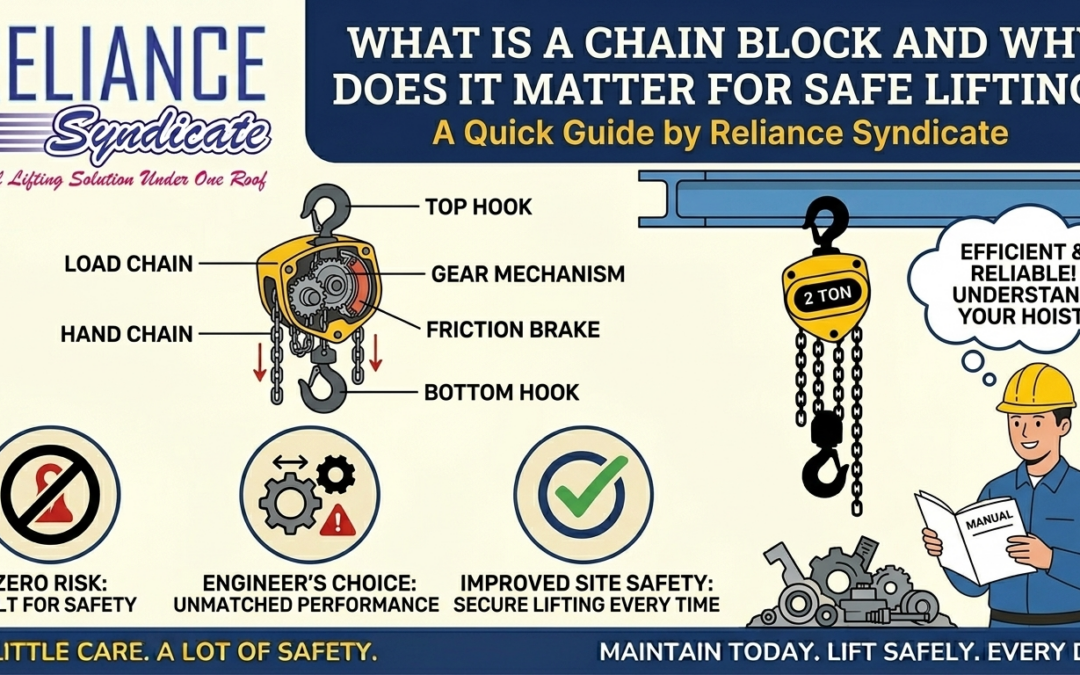
A chain block, also called a manual chain hoist, is a mechanical lifting device used to raise, lower, or suspend heavy loads. It works using a hand-operated chain that drives a gear system inside, which in turn moves a load chain attached to a hook at the bottom. Simple concept. But the engineering behind a good chain block? That’s where quality really shows.
They’re widely used in manufacturing plants, automobile workshops, shipyards, construction sites, and even in smaller fabrication units. Anywhere you need to lift something heavy without a full-blown crane setup, a chain block is what you need
The Parts You Should Know About
You don’t need to be an engineer to understand this, but knowing the basics helps you make smarter buying decisions:
• Load chain: The chain that actually carries the weight. Should be hardened steel,
ideally grade 80 or above.
• Hand chain: The one you pull manually to operate the hoist.
• Top hook: Attaches the block to a beam, trolley, or fixed structure.
• Bottom hook: This is where your load gets attached.
• Gear mechanism: The internal system that multiplies your pulling force so you can lift loads far heavier than what you could manage manually.
The Working Load Limit (WLL) is stamped on every chain block. This tells you the maximum weight it’s rated to lift safely. Never, ever exceed it.
Why Does the Quality of a Chain Block Actually Matter?
A chain block looks the same whether it’s a good one or a poor one. That’s what makes it a tricky product to buy, especially if you’re just going by price.
A low-quality chain block can:
• Have a load chain that stretches or snaps under stress
• Have a brake mechanism that slips, causing the load to drop suddenly
• Corrodes faster in humid or outdoor environments
• Have hooks that deform under load, which is as dangerous as it sounds We’ve seen this firsthand at Reliance Syndicate.
Customers come to us after a near-miss incident, or worse, after equipment failure and nine times out of ten, it’s because they picked the cheapest option available without checking the grade or the brand.
A good chain block from a trusted brand, whether it’s 1 ton, 2 ton, or up to 20-ton capacity, should have a smooth brake engagement, a heat-treated load chain, and hooks with safety latches as standard.
Who Uses Chain Blocks and For What?
Honestly, the list is long. In Coimbatore alone, which is one of India’s biggest manufacturing hubs, chain blocks are used across:
• Textile machinery installation and maintenance
• Pump and motor lifting in engineering units
• Die and mould handling in auto component factories
• Civil and structural work on construction sites
• Electrical panel and transformer installation
If your business involves lifting anything heavier than what people can do by hand, you probably need a chain block. The question is which type and what capacity, and that depends entirely on your application.
A Quick Word Before You Buy
Before you purchase a chain block, ask yourself three things:
1. What’s the maximum weight I’ll be lifting?
2. Where will this be used (indoors, outdoors, corrosive environment)?
3. And how frequently will it be operated?
These answers will point you to the right capacity, the right grade, and whether you need any additional features like a trolley mount or extended drop length.
At Reliance Syndicate, we’ve been helping industries across Tamil Nadu answer exactly these questions for over 15 years. We don’t just hand you a product; we first understand your lifting application. From 250 kg manual hoists to heavy-duty 20ton units, we stock a wide range of globally trusted brands, all under one roof at our store. Whether you’re setting up a
new facility or replacing old equipment, we’ll make sure you walk out with exactly what your application requires.
Come visit us, call us, or drop an enquiry on our website. We’re always happy to help you lift smarter and safer.