 0422 4378110
 8015010552
 sales@reliancesyndicate.com
“The machine arrived on Friday. Production was supposed to begin on Monday. By Saturday afternoon, the installation team realised they had overlooked one critical detail, the lifting equipment couldn’t safely position the machine inside the workshop.”
Situations like this are more common than many project managers expect. In fact, installation delays are often caused not by the machinery itself, but by lifting plans that were never fully evaluated before the equipment reached the site.
A machine may weigh only a few tonnes on paper, but once it’s inside a factory with limited headroom, narrow access points, or existing production lines, the lifting plan can quickly become far more complex than expected. Factors such as restricted access, uneven load distribution, overhead obstructions, and limited working space can quickly turn what appears to be a routine lift into a complex operation.
Every Installation Is Different - Even When the Machines Look Similar
Two machines with identical weights can require completely different lifting arrangements.
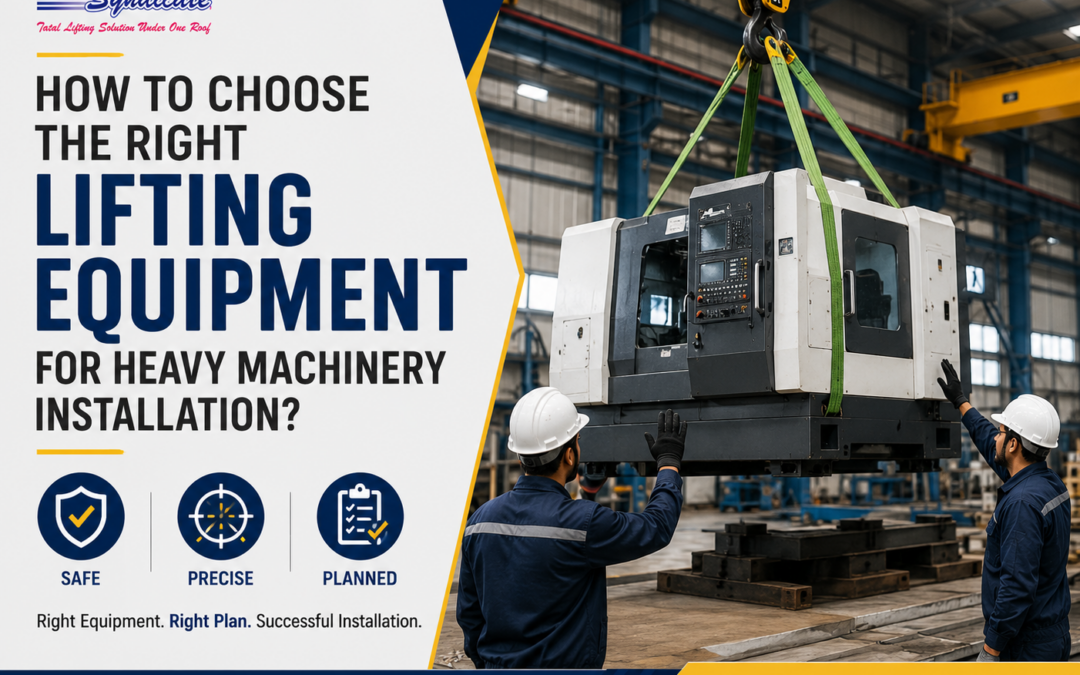
For example, a CNC machine may require extremely precise positioning during installation, whereas a fabricated steel frame may simply need to be placed on a prepared foundation. Although both operations involve lifting, the equipment and rigging approach can be completely different.
Take a fabrication press and a diesel generator as an example. Both may weigh three tonnes, but the fabrication press could have an uneven centre of gravity, while the generator may include designated lifting lugs that simplify handling. The way each machine is lifted, positioned, and secured will naturally differ.
This is why experienced installation teams rarely begin by asking, “How much does it weigh?”
Instead, they ask questions like:
-
- Where are the lifting points?
- Will the load need to be rotated?
- How much working space is available?
- Is the installation taking place in an operating factory or on a new site?
The answers to these questions often influence equipment selection more than the machine’s weight itself.
Bigger Equipment Doesn't Always Mean a Better Lift
One misconception in industrial lifting is that selecting equipment with a higher capacity automatically makes the operation safer.
In reality, oversized equipment can introduce its own challenges. A larger hoist may require additional headroom, increase the weight suspended from supporting structures, or make precision positioning more difficult inside confined workspaces. We’ve seen projects where a higher-capacity hoist created more installation challenges because it reduced available headroom and made precise positioning more difficult inside confined workshops.
In many installations, the best lifting solution isn’t the largest one, it’s the one that offers the right combination of capacity, control, and manoeuvrability for the available workspace.
Sometimes the Sling Makes the Bigger Difference
Ask experienced rigging professionals what determines a successful lift, and many will point to the lifting accessories rather than the hoist itself.
Imagine installing a newly painted machine enclosure. Using a Chain Sling simply because it’s readily available could leave scratches or surface damage before the machine is even commissioned. In that situation, Polyester Slings or Lifting Belts are often the more appropriate choice because they distribute the load while helping protect finished surfaces.
Now consider lifting a fabricated steel frame with sharp edges. The same polyester sling may no longer be suitable. A Wire Rope Sling or Chain Sling is typically better equipped to withstand the demanding conditions of that application. Experienced rigging teams usually select the sling after evaluating the load not before.
Don't Forget the Centre of Gravity
Even when the lifting equipment is correctly selected, an incorrectly balanced load can create unnecessary risks during installation. Machinery with an uneven centre of gravity may tilt unexpectedly once lifted, making accurate positioning difficult and increasing stress on lifting accessories. Identifying the centre of gravity before lifting helps improve stability and operator control throughout the installation.
Walk the Entire Lifting Route Before Installation Begins
One of the simplest yet most overlooked parts of machinery installation is checking the route the equipment will travel.
Can the forklift reach the installation area?
Will overhead piping restrict crane movement?
Is the floor capable of supporting both the machinery and the lifting equipment?
These questions rarely appear on a product specification sheet, yet they can determine whether an installation proceeds smoothly or comes to a halt halfway through.
Many project managers now involve their lifting equipment supplier during the planning stage rather than after the machinery arrives. Discussing the application early helps identify potential issues before they become expensive site problems. It’s an approach followed by many industries in Coimbatore, where experienced suppliers such as Reliance Syndicate often work with customers to recommend practical lifting solutions based on real operating conditions not simply product specifications.
Create a Lift Plan Before Installation
Before moving heavy machinery, many industrial facilities prepare a simple lift plan outlining the equipment to be used, lifting points, sling arrangement, travel path, communication methods, and potential hazards. Even for relatively straightforward installations, this planning process helps reduce unexpected delays and improves coordination between teams.
The Best Installation Is the One Nobody Talks About
When a heavy machinery installation is completed without delays, equipment damage, or safety concerns, it rarely becomes a topic of discussion. That’s because everything has worked exactly as planned. Behind that success is careful preparation, the right combination of lifting equipment and accessories, and decisions made long before the first chain is tensioned.
Choosing lifting equipment isn’t simply about moving machinery from one place to another, it’s about protecting valuable assets, supporting efficient installation, and ensuring production begins safely and on schedule.
Frequently Asked Questions
1. What lifting equipment is commonly used for heavy machinery installation?
Chain Pulley Blocks, Electric Chain Hoists, Electric Wire Rope Hoists, Wire Rope Slings, Chain Slings, Polyester Slings, and Lifting Belts are commonly selected depending on the load and installation environment.
2. Why is headroom important during machinery installation?
Insufficient headroom can prevent the hoist from achieving the required lifting height and make accurate positioning more difficult.
3. Should lifting accessories be selected before installation?
Lifting accessories should be selected after evaluating the load shape, lifting points, centre of gravity, and working conditions.
4. Why should the lifting route be inspected?
Checking the lifting route helps identify obstacles, floor limitations, access restrictions, and overhead obstructions before installation begins.