 0422 4378110
 8015010552
 sales@reliancesyndicate.com
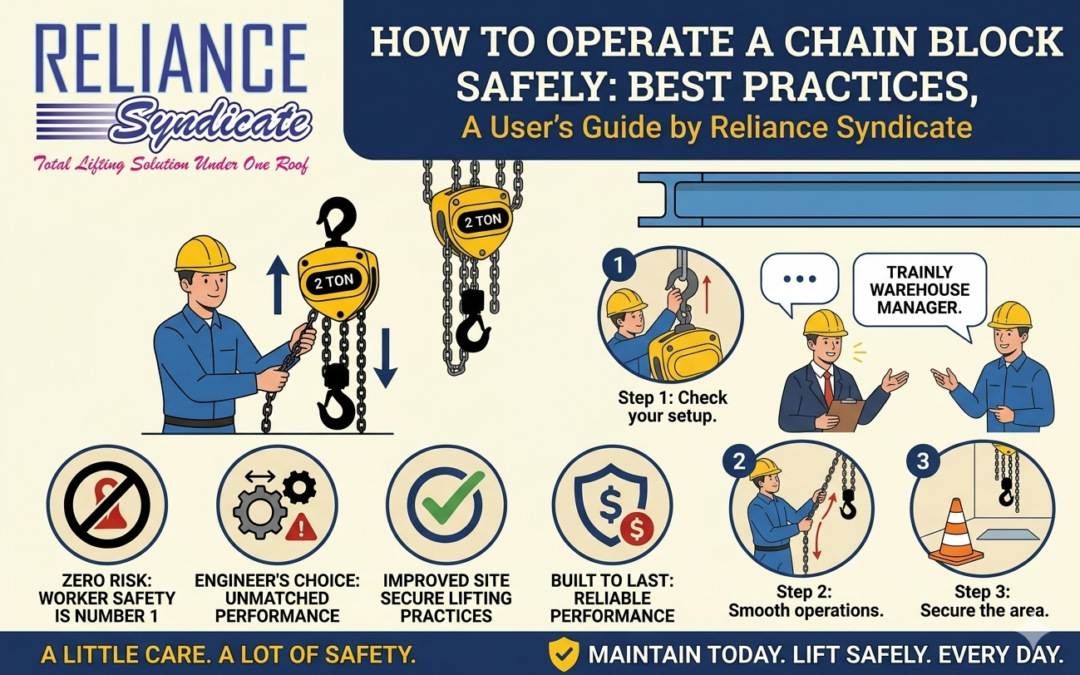
Confused between 1 ton, 2 ton, or 5-ton chain blocks? Here’s a practical guide to choosing the right capacity for your lifting needs. Buying a chain block sounds straightforward until you’re actually standing in front of a catalogue trying to figure out whether you need a 1- ton, a 3-ton, or a 5-ton hoist and whether the cheaper one on the shelf is going to cut it or not.
It’s one of the most common conversations we have with customers who walk into our store in Coimbatore. And honestly, it’s a great question to ask before you buy. So, let’s walk through this practically. No complicated engineering formulas, just real-world guidance.
Start With the Actual Weight
The most obvious starting point is the weight of the load you’re lifting. If you’re lifting a pump that weighs 800 kg, you need at least a 1-ton chain block, right?
Technically yes. But practically no, that’s not where you stop.
Here’s something most people don’t factor in: the Working Load Limit (WLL) on a chain blockis its maximum rated capacity under ideal, controlled conditions. Real-world lifting is rarely ideal. There are angles involved, there’s shock loading when you start a lift, and there’s the weight of rigging accessories like slings and hooks added on top.
A good general practice is to choose a chain block with a WLL that’s at least 25–30% higher than your actual load weight. So, for that 800 kg pump, a 1.5 ton or 2 ton chain block is a far smarter and safer choice than a 1-ton unit running at its absolute limit every single lift.
Think About How Often It Will Be Used
This is where a lot of buyers go wrong; they only think about the weight, not the workload.
A chain block used 3–4 times a week in a maintenance workshop has a very different life than one that’s running multiple shifts a day on a production floor. Manufacturers assign a usage classification to chain blocks, typically ranging from light duty to heavy duty, and this affects which model suits your operation.
If you’re in a high-frequency lifting environment, say, a casting unit or a fabrication shop in the Coimbatore industrial belt, you want a chain block built for sustained, repetitive use.
Buying a light-duty hoist for heavy-duty use will wear it out far faster than its rated lifespan, and more importantly, it becomes a safety risk.
When you’re speaking to us at Reliance Syndicate, just tell us how many lifts roughly happen per day. That single piece of information changes the recommendation significantly.
Where Is It Going to Be Used?
Location matters more than people realise. An indoor workshop with a controlled environment is very different from an outdoor construction site exposed to rain, dust, and humidity. If your chain block is going to be used in a corrosive environment near chemicals, coastal areas, or high-moisture spaces, you need one with appropriate corrosion protection on the load chain and housing.
Similarly, if the hoist is going to be mounted on a fixed beam versus a travelling trolley, that affects which top hook configuration you need. And if there are space constraints like low headroom in a basement or a compact machine room, you’ll want to look at low-headroom chain block models specifically designed for tight vertical spaces.
These aren’t minor details. They determine whether your chain block actually works well in your specific setting or just barely gets the job done. Capacity Options and What They’re Typically Used for.
Just to give you a quick real-world reference:
250 kg – 500 kg: – Small fabrication work, garage and workshop use, light machinery maintenance, electrical panel installation.
1 ton – 2 ton: – The most commonly used range across industries. Pump and motor handling, die and mould lifting, general engineering applications, and mid-size machinery installation.
3 ton – 5 ton: – Heavy machinery, transformer lifting, large structural components, automotive and heavy engineering units.
10 ton and above: – Shipyards, large-scale civil projects, heavy manufacturing, steel plants, and infrastructure work.
In Tamil Nadu and especially across Coimbatore’s manufacturing ecosystem, the 1-ton to 3- ton range moves the most, simply because of the density of mid-size engineering and textile machinery units here. But every application is different, which is why we always ask about the specific use case before making a recommendation.
Don't Forget the Lift Height
One more thing that often gets overlooked is the standard lift height on most chain blocks, which is around 3 metres. If your application needs a longer drop, like lifting from a higher beam or working in a deep pit, you need to specify that when ordering. Extended lift chains can be added, but it’s something you want sorted before the hoist arrives on site, not after.
Choosing the right chain block capacity isn’t just about matching a number to your load weight. It’s about understanding your full application, the environment, the frequency, the height, and the safety margin you need built in. At Reliance Syndicate, we’ve been doing exactly this for over 15 years, helping industries across Tamil Nadu pick lifting equipment that fits their actual needs, not just their budget. We stock chain blocks across a wide capacity range from trusted brands, and every recommendation we make is backed by real application knowledge.
Come visit us or call us before you buy. Five minutes of the right conversation can save you from a very expensive wrong decision.