 0422 4378110
 8015010552
 sales@reliancesyndicate.com
Ask someone unfamiliar with lifting equipment which specification matters most, and they’ll often point to the highest number on the product label. Bigger must be better, right? In industrial lifting, that assumption can be dangerous. One of the most misunderstood terms is Breaking Strength, while the specification that truly determines safe lifting is the Working Load Limit (WLL). Understanding the difference is essential for anyone selecting or using lifting equipment.
Ignoring the Working Load Limit doesn’t just increase the risk of equipment damage, it can compromise workplace safety and lead to costly downtime.
A Mistake That's More Common Than You Think
Many first-time buyers assume that a higher breaking strength means the equipment can safely lift heavier loads during normal operations. In reality, lifting equipment should never be selected or operated based on breaking strength alone. This misunderstanding has led to countless unsafe lifting practices across different industries.
Breaking Strength and Working Load Limit Are Not the Same
Although the two terms are often mentioned together, they serve completely different purposes.
Breaking strength refers to the load at which a lifting component is expected to fail under controlled testing conditions. It is not the weight that should ever be lifted during normal operations.
The Working Load Limit (WLL), on the other hand, represents the maximum load that lifting equipment is designed to handle safely when used correctly and under recommended conditions.
Why Buyers Often Confuse WLL and Breaking Strength
Product catalogues often display multiple technical specifications, and without proper guidance it’s easy to assume that the largest number represents the safest choice. In reality, experienced buyers focus on Working Load Limit because it reflects the equipment’s safe operating capacity not its ultimate failure point.
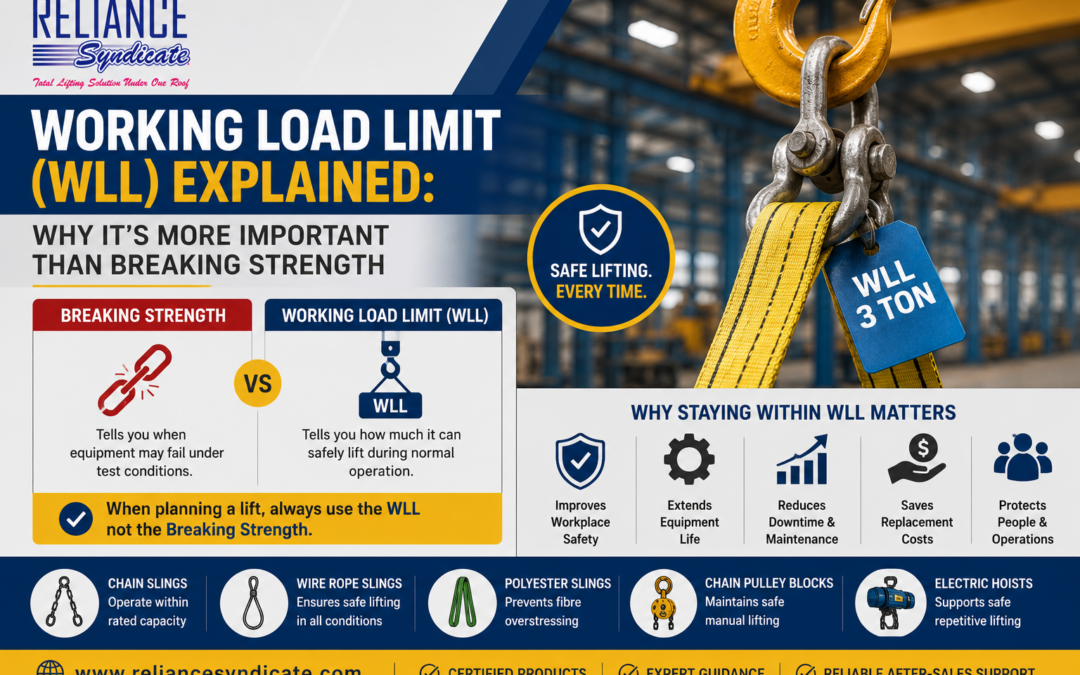
Breaking Strength tells you when equipment may fail under test conditions.
Working Load Limit (WLL) tells you how much it can safely lift during normal operation.
When planning a lift, always use the WLL not the Breaking Strength.
Why Exceeding the WLL Creates Unnecessary Risks
Overloading lifting equipment may not result in immediate failure, but it can gradually weaken critical components.
Repeatedly lifting loads beyond the recommended Working Load Limit can contribute to:
- Premature wear of lifting accessories
- Permanent deformation of components
- Reduced equipment lifespan
- Unexpected maintenance costs
- Increased safety risks for personnel
Even if the equipment appears undamaged after an overload, its structural integrity may already have been affected.
WLL Applies to More Than One Product
The Working Load Limit is an important consideration across a wide range of lifting equipment.
For example:
|
Equipment |
Why WLL Matters |
|
Chain Sling |
Prevents overloading during heavy lifting |
|
Wire Rope Sling |
Ensures safe lifting within rated capacity |
|
Polyester Sling |
Protects against fibre overstressing |
|
Chain Pulley Block |
Maintains safe manual lifting operations |
|
Electric Wire Rope Hoist |
Supports safe repetitive lifting |
Although the equipment differs, the principle remains exactly the same- operate within the Working Load Limit.
Factors That Can Affect the Effective Load
The actual load experienced by lifting equipment is often higher than the weight printed on a drawing or specification sheet.
Several practical factors influence lifting conditions, including:
- Unevenly balanced loads
- Incorrect sling angles
- Sudden starts or stops during lifting
- Dynamic loading caused by movement
- Improper attachment methods
These situations can increase the stress placed on lifting equipment, making proper planning just as important as selecting the right product.
Building WLL Awareness into Everyday Lifting
Safe lifting isn’t achieved by checking labels once during installation.
Many organisations build Working Load Limit awareness into their daily lifting procedures by:
- Confirming load weight before lifting
- Verifying equipment identification tags
- Inspecting lifting accessories before use
- Training operators on safe lifting practices
- Removing damaged equipment from service immediately
Developing these habits helps reduce the likelihood of accidents while improving consistency across lifting operations.
A Simple Example
Imagine a maintenance team needs to move a large industrial pump during scheduled servicing. The pump’s weight falls within the rated capacity of the selected Chain Sling, but the lift requires the sling to be positioned at an angle rather than vertically.
Without considering how lifting angles affect load distribution, the actual force placed on each sling leg may become significantly higher than expected. Situations like these demonstrate why understanding the Working Load Limit involves more than simply reading a number on a tag.
Let’s take another example,
Imagine a 2-ton pump being lifted using a two-leg sling. Although the pump itself weighs only 2 tonnes, lifting at an angle increases the force experienced by each sling leg. Without considering sling angles, operators may unknowingly exceed the Working Load Limit, even though the load itself appears to be within capacity.
A Quick WLL Checklist Before Purchasing Lifting Equipment
Before purchasing lifting equipment, it is worth discussing a few practical questions with your supplier:
- What is the maximum weight that will be lifted?
- Will the load be lifted vertically or at an angle?
- Which type of lifting accessory is most suitable?
- How frequently will the equipment be used?
- Are operators familiar with Working Load Limit requirements?
These conversations help ensure that equipment is selected for the actual application rather than assumptions.
Choosing Reliable Lifting Equipment
Understanding Working Load Limit is only valuable when the equipment itself is properly selected, certified, and suited to the intended application. At Reliance Syndicate, we help manufacturers, engineering companies, and maintenance teams choose lifting equipment based on real operating conditions not simply catalogue specifications while providing practical technical guidance whenever required.
Final Thoughts
Working Load Limit isn’t just another specification on a product label it’s the foundation of safe lifting. Whether you’re selecting a Chain Sling, Wire Rope Sling, Polyester Sling, or Electric Hoist, understanding WLL helps reduce risk, improve equipment life, and create safer lifting practices throughout your workplace.
Frequently Asked Questions
1. What is the difference between Working Load Limit and Breaking Strength?
Working Load Limit (WLL) is the maximum load that equipment is designed to lift safely during normal operation. Breaking Strength refers to the load at which the equipment may fail under controlled testing conditions.
2. Can I lift up to the breaking strength?
No. Breaking Strength is not an operating limit and should never be used to determine lifting capacity.
3. Why does sling angle affect Working Load Limit?
As sling angles become wider, the force acting on each sling leg increases, which can effectively reduce the safe lifting capacity of the sling arrangement.
4. Where can I find the WLL?
The Working Load Limit is usually displayed on the product label, identification tag, or manufacturer’s documentation.