 0422 4378110
 8015010552
 sales@reliancesyndicate.com
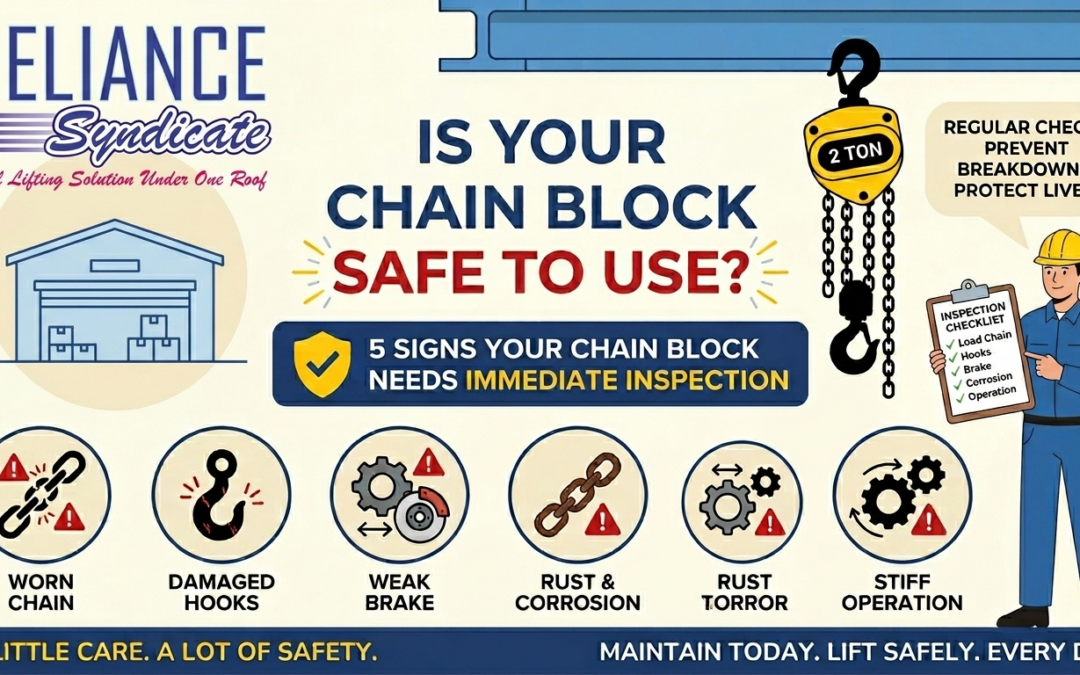
Nobody really thinks about their chain block until something goes wrong. And that’s honestly the biggest problem in most industrial setups. The chain block gets used day after day, shift after shift, and the only time anyone pays attention to it is when it stops working.
Or worse, when it fails mid-lift.
Working in the lifting equipment space for over 15 years here in Coimbatore, we’ve seen what happens when routine inspection gets skipped. It’s not correct, and it’s almost always avoidable.
So, here’s a straight-talking guide to the 5 warning signs your chain block is sending you and what to do about each one.
1. The Load Chain Looks Stretched, Worn, or Has Visible Cracks
Run your hand along the load chain (when it’s not under load, obviously). Does it feel uneven? Are any links visibly elongated compared to the others? Can you see surface cracks or rust that goes deeper than the surface?
If yes, stop using it immediately.
A load chain that’s stretched even slightly has already been compromised. The rated Working Load Limit (WLL) on your chain block assumes the chain is in its original condition. A stretched or cracked chain can snap without warning, and when that happens with a heavy load suspended in the air, the consequences are severe.
General rule of thumb: if chain elongation exceeds 3% of the original length over any 11link section, it needs to be replaced. Don’t try to gauge this by eye alone; use a chain wear gauge or get it checked professionally.
2. The Brake Isn't Holding the Load Properly
This one is easy to spot. Lift a load to a certain height, let go of the hand chain and watch.
The load should stay exactly where it is. No drift, no slow lowering, no sudden drop.
If the load creeps downward even slightly after you release the chain, your brake mechanism is worn or contaminated. Brakes in chain blocks work on a friction principle, and over time, grease contamination or worn brake pads reduce that friction significantly.
A slipping brake is one of the most dangerous faults a chain block can have. Don’t try to compensate by never leaving a load suspended. Get the brake inspected and serviced right away.
3. The Hand Chain Is Stiff, Jumpy, or Hard to Pull
Operating a chain block should feel relatively smooth. You pull the hand chain, the gears engage, and the load rises. If somewhere in that process you’re feeling unusual resistance, jerking, or the chain keeps jumping off the wheel, that’s your hoist telling you something’s wrong inside.
Common reasons include worn sprockets, a damaged or misaligned hand chain wheel, or debris and dried grease in the gear housing. Sometimes it’s as simple as a chain that’s slightly twisted or kinked. Either way, don’t force it. Forcing a stiff chain hoist can damage the internal gears rapidly and turn a minor service job into a full replacement.
4. The Hooks Are Deformed, Bent, or the Safety Latch Doesn't Click
Take a close look at both the top hook and the bottom hook. They should be symmetrical, no twisting, no visible bending, no opening of the throat (the curved part of the hook).
Hooks deform when they’ve been overloaded or side-loaded repeatedly. Even a subtle bend is enough to reduce the hook’s load capacity significantly because it changes how stress is distributed across the metal.
And the safety latch that little spring-loaded clip on the hook needs to snap back into place firmly every single time. If it’s loose, bent, or missing entirely, your load can disengage from the hook unexpectedly. It’s a small part, but it does a very important job.
5. There's Unusual Noise During Operation: Grinding, Clicking, or Rattling
A well-maintained chain block is not silent, but it has a consistent, predictable sound during operation. The moment you hear grinding, sharp clicking, or a rattling from inside the housing, pay attention.
Grinding usually means metal-on-metal contact, where there shouldn’t be any worn gears or a damaged load sheave. Clicking can indicate a pawl or ratchet issue in the brake assembly.
Rattling sometimes means a loose internal component that could cause a sudden failure.If the sound is new and you can’t immediately explain it, don’t dismiss it as “just how it sounds now.” Get it checked.
So, What Should You Do If You Spot Any of These Signs?
Take the chain block out of service. Tag it clearly so nobody else uses it in the meantime. And get it inspected by someone who actually knows lifting equipment, not just a general maintenance person.
At Reliance Syndicate, we help customers not just buy the right chain block but also understand how to maintain what they have. Whether you’re running a textile unit, an auto components plant, or a construction project anywhere across Tamil Nadu, proper lifting equipment maintenance isn’t optional. It’s what keeps your people safe and your operations running.
If you’re unsure about the condition of your chain block, reach out to us at our store in Coimbatore. A quick inspection today is a lot cheaper than an incident tomorrow.